
Senetria Blocker
NBCT Instructional Program Coordinator
Prince George’s County Public Schools
International Conference on Urban Education (ICUE), 2026
Educational Policy and Leadership | November 5, 2026
Introduction
Teacher retention remains a significant challenge for urban school districts, particularly in high-poverty schools where staffing instability can disrupt instructional continuity and student achievement (Ronfeldt et al., 2013). Although recruiting qualified educators is essential, sustainable improvement also requires school systems to create conditions that encourage effective teachers to remain.
The Blueprint for Maryland’s Future, enacted in 2021, provides a framework for strengthening Maryland’s educator workforce. Pillar 2, High-Quality and Diverse Teachers and Leaders, emphasizes teacher preparation, professional advancement, and workforce stability. This paper examines how Prince George’s County Public Schools (PGCPS) can advance these priorities through National Board Certification incentives, Grow Your Own initiatives, residency partnerships, induction supports, and professional learning communities.
Teacher Retention: Progress and Persistent Challenges
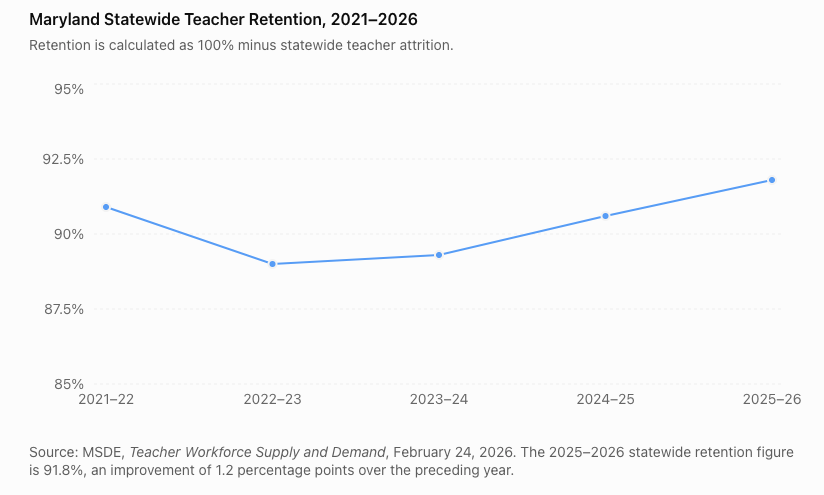
Recent Maryland workforce data indicate encouraging progress. Statewide teacher attrition declined from 9.4% in 2024–2025 to 8.2% in 2025–2026, representing an increase in statewide retention from 90.6% to 91.8% (Maryland State Department of Education [MSDE], 2026). The state also reported a 45.3% reduction in teacher vacancies over the same period. Although these improvements are promising, they do not establish that the Blueprint caused the changes or demonstrate equivalent improvements within PGCPS.
Figure 1
Maryland Statewide Teacher Retention, 2021–2026
School year Retention Visual comparison 2021–2022 90.9%██████████████████2022–2023 89.0%████████████████2023–2024 89.3%████████████████2024–2025 90.6%██████████████████2025–2026 91.8%███████████████████
Note. Bars provide a visual comparison of retention percentages and do not begin at zero. Retention equals 100% minus statewide teacher attrition. These figures represent Maryland, not PGCPS. Source: MSDE (2026).
PGCPS's earlier teacher separation data illustrate the importance of sustained attention to retention. District separation rates ranged from 13.8% in fiscal year 2019 to 7.6% in fiscal year 2021. Of 2,703 voluntary resignations examined between fiscal years 2018 and 2021, more than 46% involved teachers with fewer than three years of experience, and 38.8% involved teachers with three to fewer than eight years of experience (PGCPS, 2022). These figures describe the distribution of resignations, not resignation rates within each experience group.
Statewide disparities also persist. In 2024–2025, inexperienced teachers represented 25.4% of educators in high-poverty schools compared with 11.2% in low-poverty schools (MSDE, 2026). These patterns reinforce the need for retention strategies that prioritize both early-career support and educational equity.
The Blueprint and District-Level Retention Strategies
Pillar 2 promotes a more stable and accomplished teaching workforce through improved preparation, professional recognition, and career advancement. Its teacher career ladder is especially important because it creates opportunities for accomplished educators to advance professionally without necessarily leaving classroom instruction. However, meaningful advancement must be accompanied by supportive leadership, reasonable responsibilities, and positive working conditions (Carver-Thomas & Darling-Hammond, 2017).
PGCPS's Forward by Design: Acceleration 2029 strategic plan complements these priorities through its emphasis on recruiting and retaining staff, strengthening onboarding, developing talent pipelines, and expanding professional learning (PGCPS, n.d.).
Five interconnected strategies offer a framework for implementation.
Grow Your Own initiatives can develop future teachers from existing school employees and community members, potentially strengthening connections between educators and the communities they serve.
Residency partnerships can provide prospective teachers with sustained classroom experiences and mentorship, helping bridge the transition from preparation to professional practice.
Induction and mentoring supports can address the challenges of early-career teaching through structured guidance, feedback, and professional relationships.
Professional learning communities can strengthen teacher efficacy and belonging by creating opportunities for collaboration, shared problem-solving, and instructional improvement.
National Board Certification incentives can recognize accomplished teaching and create pathways for professional growth. Maryland reported a 39% increase in National Board Certified Teachers between October 2024 and October 2025 (MSDE, 2026). PGCPS has also provided certification-related compensation through negotiated agreements, including differentiated incentives for eligible teachers serving in designated low-performing schools (Prince George's County Educators' Association & Board of Education of Prince George's County, 2022).
Together, these approaches address multiple stages of a teacher's career, from preparation and entry to professional development and advancement. Their retention impact, however, must be evaluated through longitudinal district data rather than participation counts alone.
Implications and Conclusion
The Blueprint offers PGCPS an opportunity to connect state policy with practical school-level supports. Successful implementation requires equitable access to professional pathways, effective school leadership, and ongoing examination of retention outcomes by teacher experience and school context. Research underscores that leadership and working conditions are central to teachers' decisions to remain (Grissom et al., 2021).
Maryland's recent workforce improvements are encouraging, but retention remains an educational equity priority. By coordinating Grow Your Own initiatives, residency partnerships, induction, professional learning communities, National Board Certification, and career advancement, PGCPS can build a more coherent approach to sustaining its educator workforce.
The goal is not simply to recruit more teachers. It is to create schools where effective teachers have meaningful reasons to stay.
References
Carver-Thomas, D., & Darling-Hammond, L. (2017). Teacher turnover: Why it matters and what we can do about it. Learning Policy Institute. https://learningpolicyinstitute.org/product/teacher-turnover-report
Grissom, J. A., Egalite, A. J., & Lindsay, C. A. (2021). How principals affect students and schools: A systematic synthesis of two decades of research. The Wallace Foundation. https://doi.org/10.59656/EL-SB1065.001
Maryland State Department of Education. (2026, February 24). Teacher workforce supply and demand [Presentation to the Maryland State Board of Education].
Prince George's County Educators' Association & Board of Education of Prince George's County. (2022). Negotiated agreement, July 1, 2022–June 30, 2025. https://pgcea.org/negotiated-agreement-2/
Prince George's County Public Schools. (2022). Teacher separation: Fiscal years 2018–2021 [Data brief]. https://www.pgcps.org/globalassets/offices/testing-research-and-evaluation/docs---testing/research-and-evaluation/teacher-separation-data-brief-sy2018-sy2021.pdf
Prince George's County Public Schools. (n.d.). Forward by Design: Acceleration 2029. https://www.pgcps.org/strategic-plan/
Ronfeldt, M., Loeb, S., & Wyckoff, J. (2013). How teacher turnover harms student achievement. American Educational Research Journal, 50(1), 4–36. https://doi.org/10.3102/0002831212463813