
The Power of Timelines
While reading Irene Fusilli’s article on movement-based social studies activities, one strategy instantly stood out to me: human timelines. In this activity, students become the timeline by arranging themselves in chronological order, each holding a sign or prop that represents a specific event. By researching the date, writing a summary, and finding an image for the moment they represent, students take real ownership of their place in history—turning abstract facts into something they can literally stand in.
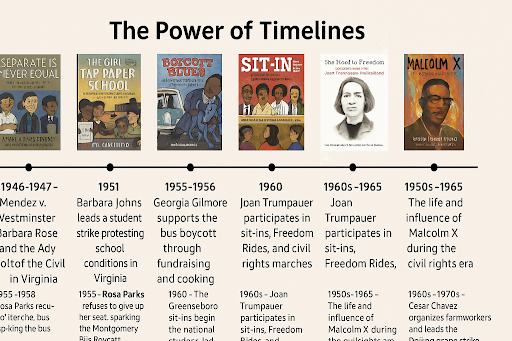
I’ve used timelines in several meaningful ways in my teaching; for example, my students have explored a specific period, like the civil rights movement. To complete this activity, I had students read picture books and place them in chronological order to see how events and activism unfolded. There are so many rich picture books that capture the lives and events from this subject, such as the story of Sylvia Mendez and her family’s fight for school desegregation in Separate Is Never Equal; the powerful biography of Rosa Parks in Boycott Blues, which highlights how her refusal to give up her seat sparked the Montgomery Bus Boycott, and books that explore the leadership and legacy of Dr. Martin Luther King Jr., whose speeches and activism shaped the movement nationwide. These texts help students see the movement through real people and pivotal moments that shaped history.
Using books like the ones listed below, I would first give students time to read as many titles as possible. I could also read books aloud for a shared classroom experience and set up a listening center so students can listen to stories in a format that best meets their needs. As they read, students would outline key events and record important dates. Then, using their outlines, they would work in pairs or small groups of three or four to build a chronological timeline
History Timeline Through Picture Books
1946–1947 – Separate Is Never Equal (Mendez v. Westminster)
1951 – The Girl from the Tar Paper School (Barbara Johns’ school strike)
1955–1956 – Boycott Blues and Pies from Nowhere (Montgomery Bus Boycott)
1960 – Sit-In (Greensboro sit-ins)
1960s – She Stood for Freedom (Joan Trumpauer Mulholland)
1950s–1965 – Malcolm X: A Fire Burning Brightly
1960s–1970s – Harvesting Hope (Cesar Chávez and the farmworker movement)
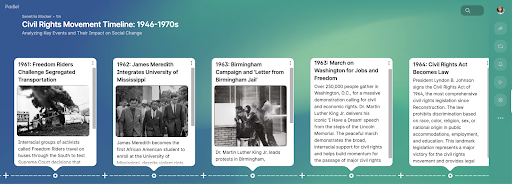
Once students have created their outlines, there are many ways they can bring their timelines to life. They might use the traditional approach, writing their ideas on a notebook or plain paper, or work together on chart paper to design a larger, shared timeline. Another option is for each student to focus on one significant date; their individual papers can then be posted in sequence to form a long, interactive classroom timeline, followed by a gallery walk for students to explore and discuss the events. Students could also use technology such as Padlet, which has a timeline feature, to create a timeline (pictured below).
I also use timelines with fiction: students map out key moments in the story to better understand how events build, connect, and shape the characters’ journeys.
When students move, visualize, and embody the sequence of events, comprehension deepens. Timelines, especially interactive and creative ones, give learners a clear pathway through content, helping them connect cause and effect, track growth, and understand how one moment leads to the next. It’s a simple strategy that consistently strengthens understanding.